
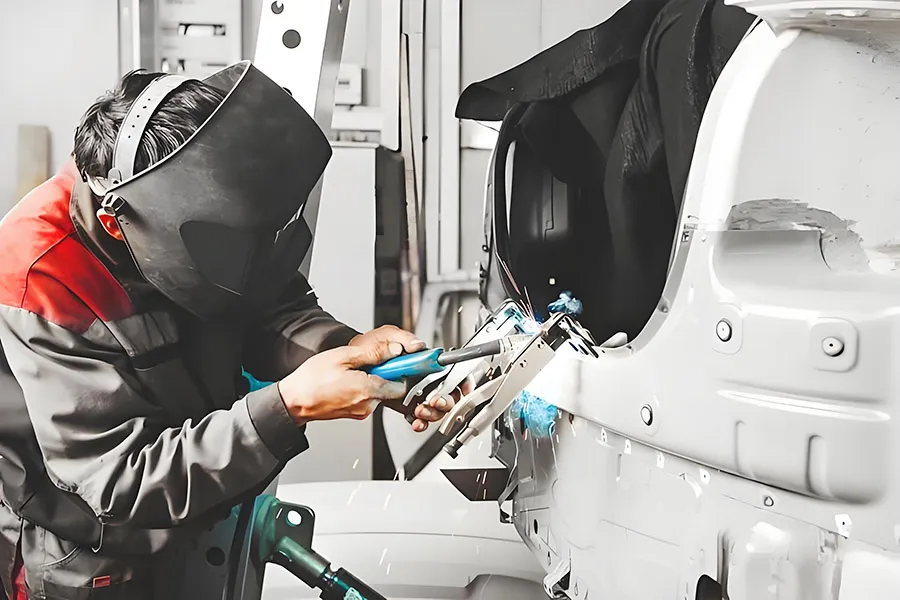
With the rapid development of modern manufacturing technology, laser beam welding automotive industry technology due to its advantages such as high efficiency, high precision and high adaptability. As an advanced welding technology, laser welding has become an indispensable part of the automotive manufacturing process.
1. Types of industrial lasers
There are two main types of industrial lasers in structural manufacturing: CO2 lasers and YAG lasers.
| Features | CO₂ laser | YAG laser |
|---|---|---|
| Laser medium | Gas (CO₂) | Solid (Neodymium-doped aluminum garnet) |
| Wavelength | 10.6 μm (infrared) | 1064 nm (near infrared) |
| Application materials | Metal, non-metal | Mainly used for metal |
| Beam quality | Good | Excellent |
| Cutting and welding capabilities | Suitable for cutting and welding of thick materials | Suitable for high-precision welding and cutting |
| Equipment cost | Usually low | Usually high |
2. Application of Laser Beam Welding Automotive Industry
Laser welding has found countless application scenarios in the automotive industry and has changed the way cars are made.
Laser welding has several advantages.
Body Assembly
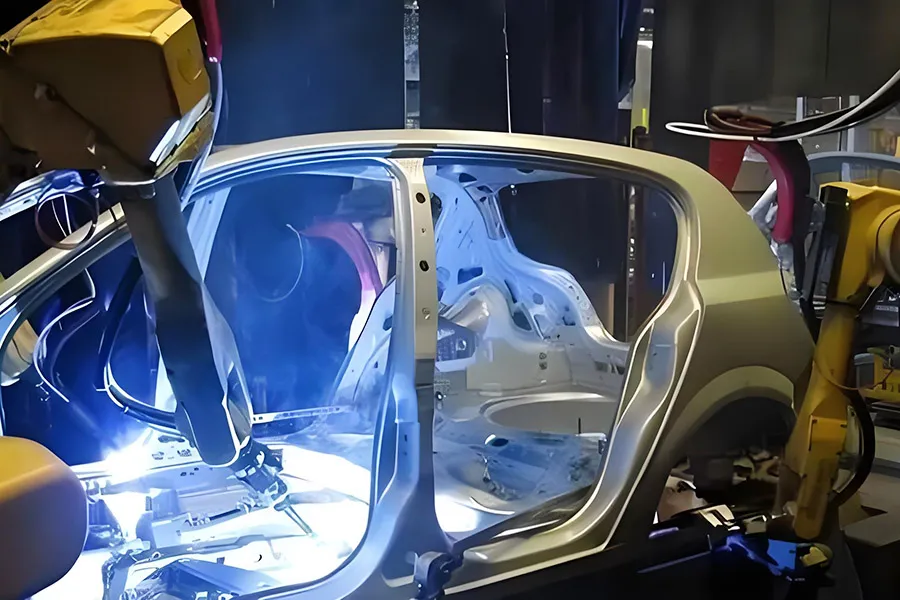
Laser welding plays an important role in the joining of automotive body parts such as roof panels, doors, hoods and floor fans. Strong, aesthetically pleasing welds enable smooth integration and structural integrity.
Powertrain Components
Laser welding is used to manufacture powertrain components, including engine blocks, cylinder heads and transmission components. The technology ensures precise alignment and high-quality welds for optimal performance and longevity.
Suspension Systems
Laser welding is used to manufacture suspension components such as control arms and subframes. It facilitates the joining of dissimilar materials such as aluminum and steel to form light and strong components.
Battery Pack Assembly
With the advent of electric vehicles, laser welding is indispensable for battery pack assembly. The technology enables precise welding of battery cells, ensuring electrical conductivity, thermal management and overall safety.
Interior and Exterior
Laser welding is used in the production of exterior and interior components such as door frames, pillars, and decorative sockets. The technology allows for smooth, aesthetically pleasing welds that enhance the overall appearance of the tea lounge.
Exhaust Systems
Laser welding is an ideal method for joining exhaust system components due to its high temperature and corrosion resistance. Ensuring leak-free, durable connections helps improve vehicle performance and reduce tailpipe emissions.
Safety Components
Laser welding is used to make safety-critical components such as airbag inflator shells and seatbelt anchors. The technology ensures strong and stable welds, which are critical to passenger safety.
Lightweight Initiative
Laser welding plays a pivotal role in the automotive lightweighting strategy. By combining different materials and using thinner, lighter components, laser welding helps reduce vehicle weight, thereby improving fuel efficiency and reducing tailpipe emissions.
3. Advantages of Laser Beam Welding Automotive Industry Manufacturing
Improved Precision
Laser welding offers superior precision and control, allowing for extremely precise welds with minimal distortion. The focused laser beam ensures concentrated heat application, minimizing precise fusion and heat-affected zones. This degree of precision is critical for automotive manufacturing where tight tolerances and structural integrity are paramount.
Excellent Quality and Strength
Laser welding produces high-quality welds with excellent mechanical properties. The technology produces narrow and deep welds through a strong metallurgical bond, ensuring the integrity and durability of the joint. This strength is critical for automotive applications where safety and reliability are paramount.
Versatility and design flexibility
Laser welding is well suited to joining different types of metals, including steel, aluminum, and dissimilar materials. It is this versatility that allows automotive manufacturers to strategically combine different materials to optimize strength, weight, and performance. In addition, laser welding can accommodate complex joint designs, facilitating the manufacture of complex automotive parts.
Improved productivity
Laser welding has significantly improved productivity in the automotive industry. The welding speed is fast, the cycle time is long, and the process is fast. No additional steps such as preheating or post-weld treatment are required, which reduces overall production time. Automated laser welding systems can also be integrated into assembly lines to simplify the manufacturing process and increase productivity.
Reduced costs
The initial investment in laser welding equipment may be higher than traditional welding methods, but the long-term benefits can lead to significant cost reductions. The precision and efficiency of laser welding reduces material waste, reduces labor costs, and minimizes the need for rework or repairs. In addition, the high reproducibility of the technology ensures consistent quality, thereby reducing the risk of expensive recalls or warranty claims.
Summary
The application of laser beam welding automotive industry demonstrates its important position in modern manufacturing. With the continuous advancement and innovation of technology, laser welding will play a more important role in the field of automotive manufacturing, bringing more high-quality and high-performance automotive products to consumers and pushing the entire automotive industry to a new height.