
In modern automobile manufacturing, welding technology is one of the key processes for connecting various materials and components. With the continuous advancement of technology, laser welding, as an emerging welding method, has gradually occupied an important position in the automotive industry. This article will explore in depth the advantages and challenges of automotive laser welding.
1. What are the applications of automotive laser welding?
Car body welding
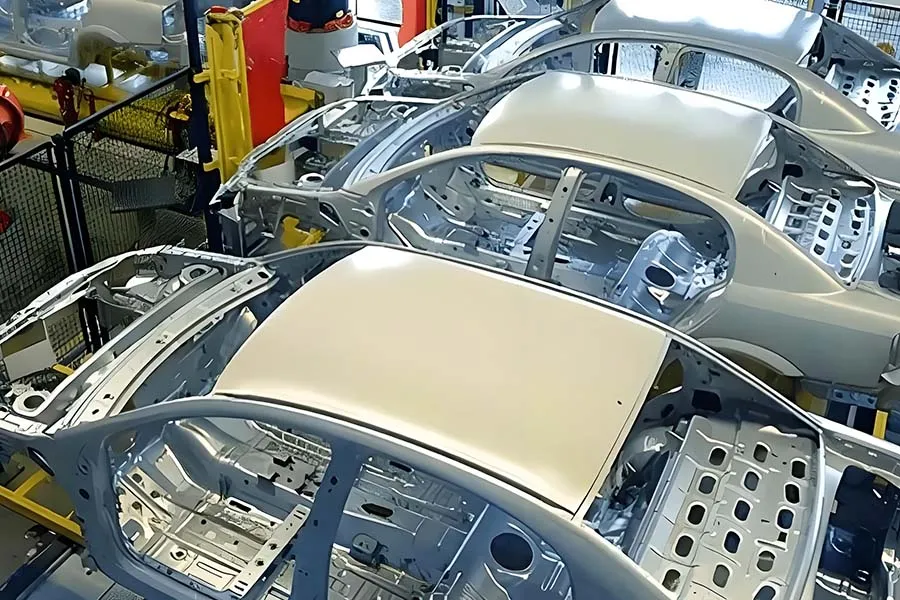
Most of the automotive laser welding is used in the assembly and connection of car body stamping parts, mainly including the laser welding of the roof cover, trunk cover and frame. Another important one is the car body laser welding, which is about the car body structure, including doors, body side frames and pillars. The use of laser welding can improve the strength of the car body and solve the problem of conventional resistance spot welding.
Unequal thickness laser welded plates
The use of unequal thickness laser welded plates in car body manufacturing can reduce the weight of the car body, reduce the number of parts, improve safety and reliability, and reduce production costs, but this has extremely high requirements for welding technology.
Gear and transmission parts welding
In addition, various parts of the gearbox can be welded on this equipment, especially the differential case and drive shaft in the car gearbox, which are often welded together after the individual parts are produced.
2. Advantages
High-precision and high-quality welding
The laser beam spot is extremely small, which can achieve precise energy focusing, which allows laser welding to be performed in a very small area, greatly improving the welding accuracy. In automobile manufacturing, such as the welding of the body frame, high-precision welding ensures the precise docking of various parts of the body, reduces welding deformation, and improves the overall strength and safety of the body. For example, in the welding of car doors, laser welding can ensure uniform and beautiful welds, and the welding strength is about 30% higher than that of traditional welding methods.

High efficiency and high speed
Laser welding is fast and can complete a large amount of welding work in a short time. Compared with traditional welding technology, laser welding can greatly shorten the welding time and improve production efficiency. In the automobile production line, this means that more cars can be produced per unit time to meet the market’s growing demand for cars. For example, in the welding process of the car chassis, laser welding technology can increase the welding speed several times, effectively improving the efficiency of the entire production line.
Good material adaptability
Laser welding technology is suitable for a variety of metal materials, including different types of steel, aluminum alloy, etc. In automobile manufacturing, in order to reduce the weight of the car body and improve fuel economy, the use of lightweight materials such as aluminum alloy is becoming more and more widespread. Laser welding can well realize the welding between aluminum alloy materials and between aluminum alloy and steel, meeting the demand for material diversification in automobile manufacturing.
Reduce production costs
Although the initial investment of laser welding equipment is relatively high, in the long run, due to its efficient production speed, high-quality welding effect and low scrap rate, it can effectively reduce the overall cost of automobile production. High-precision welding reduces the subsequent grinding and trimming of the welding parts, saving manpower and time costs. Moreover, good welding quality reduces the product scrap rate caused by welding defects, further saving production costs.
3. Challenges
Due to the small laser focus spot size and narrow weld seam, laser welding has high requirements for workpiece assembly accuracy. The position of the welded parts must be very accurate, requiring that the position of the beam on the workpiece cannot have obvious offset and must be within the focusing range of the laser beam. If the workpiece assembly accuracy or beam positioning accuracy does not meet the requirements, welding defects are very likely to occur.
The laser fill welding process is difficult to control. Laser fill welding is a fusion welding process, where the focused light spot is irradiated on the workpiece and the welding wire respectively. The molten pool is small, and it is very important to accurately control the relative position of the light so that the continuously fed welding wire can be melted evenly. The weld solidifies quickly and may have porosity and embrittlement defects.
Summary
As an advanced welding technology, automotive laser welding has many advantages such as high precision, high speed, low heat-affected zone and wide material adaptability, and is gradually becoming an important process in automobile manufacturing. However, the challenges of high operating technology requirements and complex welding joint design are all difficulties that need to be overcome in practical applications of laser welding.