
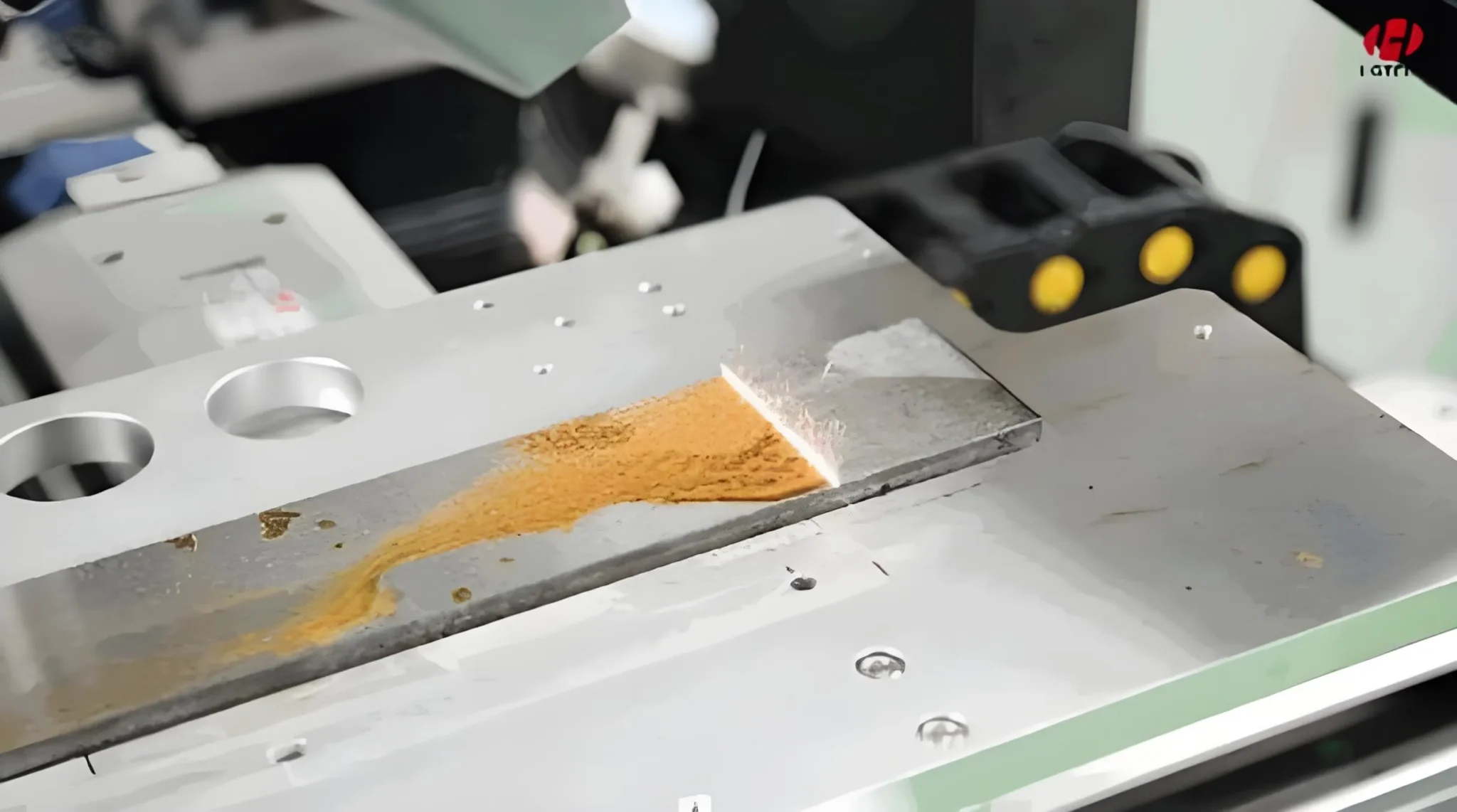
Laser industrial cleaning is a process that uses laser technology to remove pollutants or coatings on the surface of an object. This technology is widely used in many industrial fields, so how does the laser perform cleaning work? Let’s take a look.
1. Principle of laser industrial cleaning
Laser rust removal: Using the high energy, high frequency, and high power characteristics of lasers, high energy is instantly deposited in a very small area, and the oxide layer is burned at high temperature, which is also called laser cleaning.
Its physical principles can be summarized as follows:
- The beam emitted by the laser is absorbed by the contaminated layer to be treated;
- The absorption of large energy forms a rapidly expanding plasma and generates shock waves;
- The shock wave breaks the pollutants into fragments and removes them;
- The width of the light pulse must be short enough to avoid heat accumulation and damage to the surface to be treated.

2. What are the types of laser cleaning?
2.1 Laser dry cleaning
Dry laser cleaning is the direct irradiation of pulsed lasers to clean the workpiece, so that the substrate or surface pollutants absorb energy and the temperature rises, resulting in thermal expansion or thermal vibration of the substrate, and then the two are separated. This method is roughly divided into two cases: one is that the surface pollutants absorb the laser to expand; the other is that the substrate absorbs the laser to generate thermal vibration.
2.2 Laser wet cleaning
Before the pulsed laser irradiates the workpiece to be cleaned, a liquid film is first applied to the surface. Under the action of the laser, the temperature of the liquid film rises rapidly and vaporizes. At the moment of vaporization, a shock wave is generated, which acts on the pollutant particles and causes them to fall off the substrate. This method requires that the substrate and the liquid film cannot react, so the range of application materials is limited.
2.3 Laser plasma shock wave cleaning
Laser plasma shock wave is a spherical plasma shock wave generated by breaking through the air medium during laser irradiation. The shock wave acts on the surface of the substrate to be cleaned and releases energy to remove pollutants; the laser does not act on the substrate, so it does not damage the substrate. Laser plasma shock wave cleaning technology can now clean particle pollutants with a particle size of tens of nanometers, and there is no restriction on the laser wavelength.
3. Application of laser industrial cleaning
Compared with traditional cleaning methods such as mechanical friction cleaning, chemical cleaning, and high-frequency vibration cleaning, laser cleaning technology has many significant features:
- Green and environmentally friendly: Laser cleaning technology does not require the use of chemicals and does not produce waste liquid to pollute the water body;
- Little damage to the substrate: It does not require contact with the substrate, nor does it require any mechanical force to be applied to the substrate;
- Highly flexible: It is easy to achieve automation;
- Excellent cleaning effect: Lasers with different wavelengths and different processing parameters can easily clean various pollutants attached to the surface of the substrate;
- It has high cleaning efficiency: Laser cleaning equipment using scanning technology can convert point light sources into line or surface light sources, which results in a cleaning speed that is much higher than that of traditional cleaning technologies.
4. Advantages of laser industrial cleaning
- Compared with traditional cleaning methods such as mechanical friction cleaning, chemical cleaning, and high-frequency vibration cleaning, laser cleaning technology has the following many significant features:
- It is green and environmentally friendly. Laser cleaning technology does not require the use of chemicals and will not produce waste liquid to pollute the water body;
- It causes little damage to the substrate. It does not require contact with the substrate, nor does it require any mechanical force to be applied to the substrate;
- It is highly flexible. It is easy to achieve automation;
- It has excellent cleaning effect. Selecting lasers with different wavelengths and different processing parameters can easily clean various pollutants attached to the surface of the substrate;
- High cleaning efficiency. Laser cleaning equipment using scanning technology can convert point light sources into line or surface light sources, which results in a cleaning speed that is much higher than traditional cleaning technology.
Summary
Laser industrial cleaning is an efficient, fast and environmentally friendly surface treatment technology, especially suitable for occasions where precise cleaning is required and traditional physical or chemical cleaning methods cannot be used.
If you are also interested in laser industrial cleaning, please contact us now to get the best quote!