
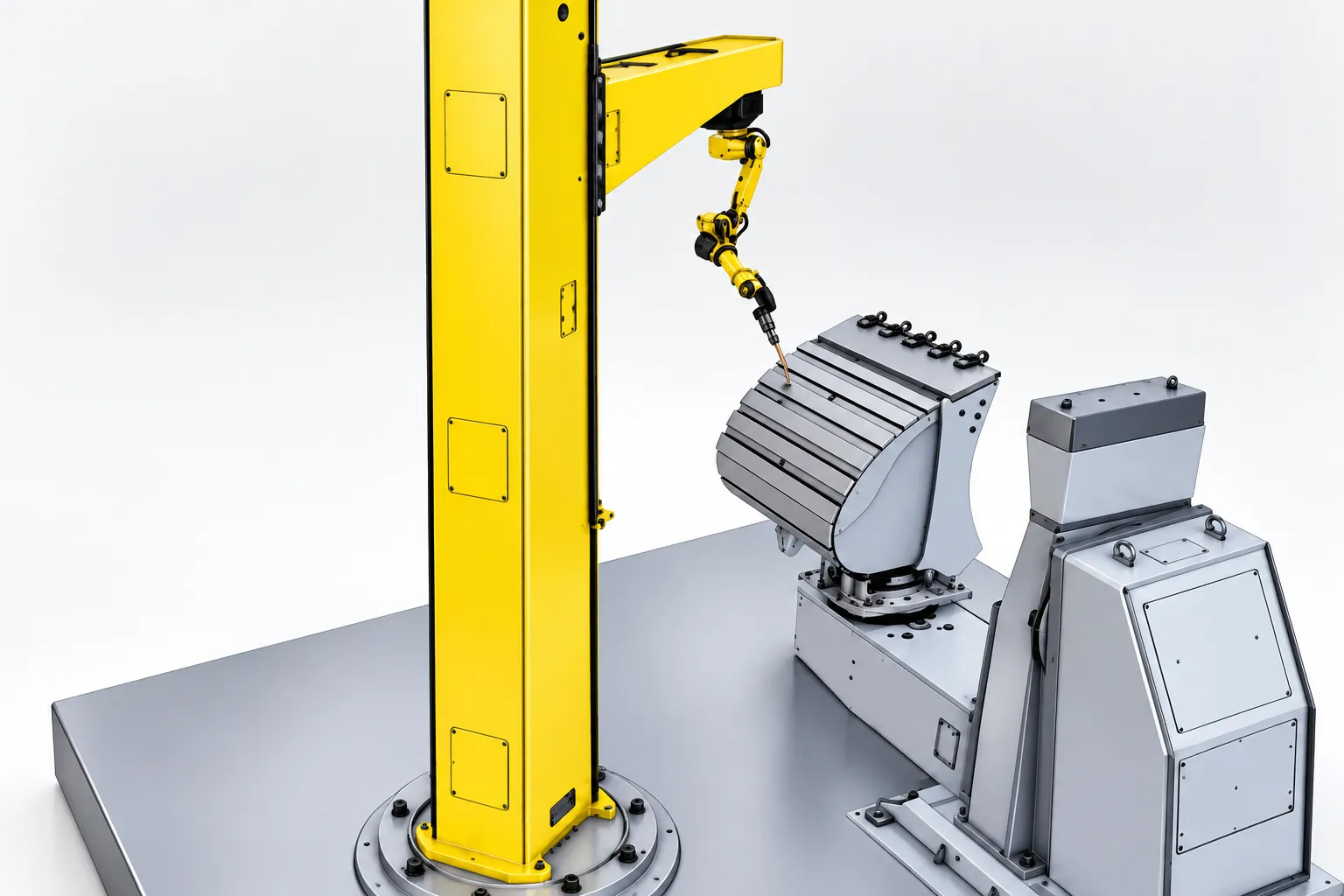
A heavy machinery manufacturer from Colombia contacted UMW to explore an automated welding solution for excavator structural components. The customer needed to weld large steel parts with multiple weld seams and complex welding positions. As production requirements increased, manual welding made it more difficult to maintain consistent weld quality and production efficiency.
After reviewing the workpiece structure and welding requirements, UMW developed a customized robotic welding solution to help the customer achieve a more stable and standardized welding process.
Customer & Industry Background
The customer is a Colombian manufacturer serving the construction machinery industry, with excavator structural components forming an important part of its production.
Excavator components typically involve large steel structures, multiple welded joints, and demanding load-bearing requirements. Weld quality directly affects the strength and reliability of the finished structure.
For the customer, the main objective was not simply to replace manual welding, but to establish a welding process that could provide better consistency during repeated production.
Workpiece & Welding Requirements
The project focused on excavator structural components made from structural steel.
These parts feature relatively large dimensions and contain multiple weld seams distributed across different surfaces and angles. Some welding paths are long, while others require the welding torch to operate around complex structural features.
The customer therefore required a solution capable of providing:
- Stable welding along long seams
- Consistent weld formation
- Flexible handling of different welding positions
- Repeatable welding paths
- Reliable welding for heavy-duty structural parts
- Reduced dependence on manual operation
For excavator components, maintaining stable welding parameters and torch movement is especially important because the finished parts must withstand continuous mechanical loads during operation.
Challenges with Manual Welding
Before considering automation, the customer relied mainly on manual welding for these structural components.
However, several challenges became increasingly apparent as production requirements increased.
Inconsistent Weld Quality
Manual welding results can vary depending on the operator’s experience, working position, and welding conditions. Maintaining the same travel speed and torch angle throughout long weld seams can be difficult.
High Labor Intensity
Excavator components are relatively large and often require long periods of continuous welding. This increases operator workload, particularly when welding in difficult positions.
Complex Welding Positions
Different weld seams are located at different angles and heights. Operators need to repeatedly reposition themselves or adjust the workpiece, which can affect both efficiency and welding consistency.
Limited Production Standardization
For repeated production, relying heavily on manual operation makes it more difficult to maintain the same welding process from one workpiece to the next.
The customer therefore began looking for an automated system that could provide more repeatable welding performance.
Cantilever-Type Multi-Axis Coordinated Robotic Welding System
UMW Cantilever-Type Multi-Axis Coordinated Welding Solution
Based on the size, structure, and weld distribution of the excavator components, UMW recommended a cantilever-type multi-axis coordinated robotic welding system for the Colombian customer.
Unlike a conventional fixed robotic welding setup, this system combines a cantilever motion structure with a multi-axis welding mechanism and workpiece positioner. Multiple axes operate in coordination, allowing the welding torch and workpiece to change position continuously according to the programmed welding path.
This configuration provides a larger working range and greater flexibility for welding large and complex excavator structural components.
Large Working Range
The vertical column and cantilever structure extend the effective welding area, making the system suitable for relatively large structural components.
The welding head can move to different positions around the workpiece without requiring frequent manual repositioning.
Multi-Axis Coordinated Motion
The welding mechanism works together with the positioner through multi-axis coordinated control.
During welding, the system can adjust the torch position, welding angle, and workpiece orientation simultaneously, helping maintain a suitable welding posture along complex seams.
Automatic Workpiece Positioning
The integrated positioner rotates and tilts the workpiece according to the programmed welding sequence.
This allows weld seams located on different sides of the excavator component to be brought into more suitable welding positions, reducing manual handling during the process.
Programmable Welding Paths
UMW engineers program the welding trajectory according to the actual geometry and weld locations of the customer’s workpiece.
Once the welding program is established, it can be reused for repeated production of the same component, improving process consistency.
Stable Welding Parameters
The automated system maintains controlled welding speed, torch movement, and welding parameters throughout the programmed path, helping reduce variations caused by manual operation.
Welding Test & Process
1. Workpiece Analysis
UMW engineers analyzed the excavator component dimensions, weld seam locations, welding angles, and required movement range.
2. Workpiece Clamping
The component was securely mounted on the positioner to ensure stable positioning throughout the welding process.
3. Multi-Axis Path Programming
The welding path was programmed based on the actual weld geometry. The movement of the cantilever, welding mechanism, and positioner was coordinated within the same welding sequence.
4. Welding Parameter Setup
Suitable welding parameters were configured according to the workpiece material, joint type, and welding requirements.
5. Coordinated Automatic Welding
During operation, the welding torch and positioner moved together according to the programmed path, allowing the system to continuously adjust the welding position and angle.
6. Weld Inspection
After welding, the completed seams were checked for continuity, weld formation, and overall consistency.
Welding Results
The robotic welding process produced consistent weld seams across the programmed welding paths.
Compared with manual operation, robotic control provides more stable torch movement and welding speed, helping reduce variations between different welds.
For repeated excavator component production, the customer can also reuse established welding programs instead of setting up the welding process from the beginning for every workpiece.
The solution provides several practical benefits:
- More consistent weld formation
- Stable welding along long seams
- Reduced variation caused by manual operation
- Lower operator workload during repetitive welding
- Repeatable welding programs for batch production
- More standardized production processes
Most importantly, the system gives the customer a foundation for gradually expanding automation within its construction machinery production process.
Building a More Standardized Welding Process
For heavy machinery manufacturers, robotic welding is not only about increasing welding speed.
Large structural components such as those used in excavators require stable weld quality, repeatable processes, and flexible automation capable of adapting to different workpiece geometries.
By introducing a customized robotic welding solution, the Colombian customer can reduce dependence on repetitive manual welding while establishing a more consistent and scalable production process.
UMW provides customized robotic welding solutions based on actual workpiece dimensions, materials, weld types, production volumes, and factory layouts.
If you are considering automation for excavator components, construction machinery, structural steel, or other large welded parts, UMW can develop a robotic welding solution around your specific production requirements.